Glossary

What is Virtual Terminal?

Virtual Terminal is a web-based application that allows merchants to manually enter and process credit card payments through a computer or mobile device without requiring a physical card reader. Virtual Terminals enable Card Not Present transactions by providing a secure interface for businesses to input payment details, verify customer information. And complete transactions remotely, often used for phone, mail. Or invoice orders.

Sources reviewed: Payment Card Industry Security Standards Council, Federal Trade Commission – Card Not Present Transactions

Quick Facts About Virtual Terminal

Category

Payment processing tool

Used for

Manual credit card entry for remote transactions

Common confusion

Often mistaken for a Payment Gateway, which automates online transactions

Also called

Web Terminal, Browser Terminal

Often discussed with

Credit Card Payment Processing, Online Credit Card Processing

Key Takeaways About Virtual Terminal

Understanding Virtual Terminal
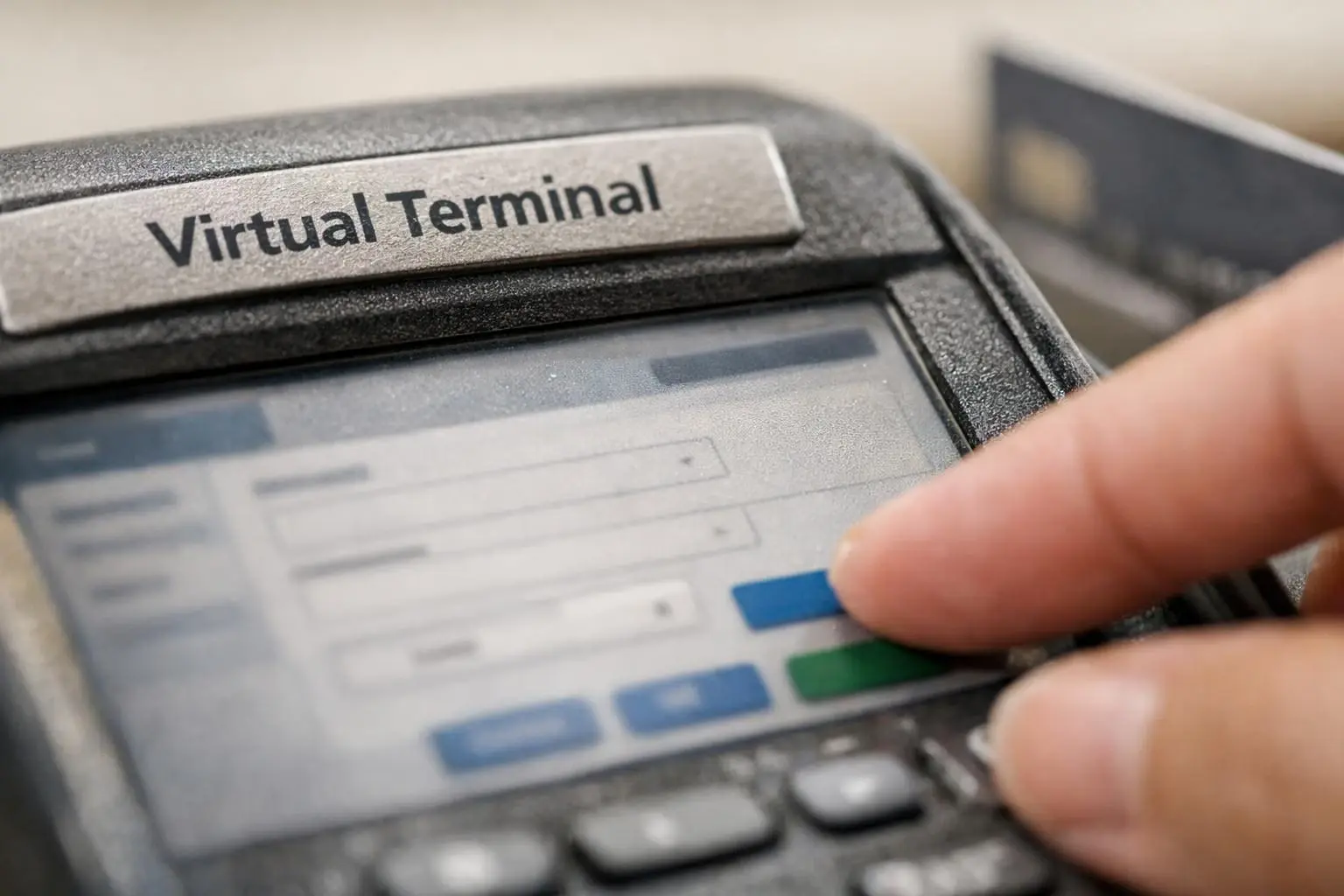
Virtual Terminal in Credit Card Processing: Virtual Terminal is a web-based application that allows merchants to manually...

A Virtual Terminal is a secure, web-based interface. It lets merchants process credit card payments without a physical card reader or in-person transaction.

Related glossary terms: Card Not Present, Payment Processor, PCI Compliance.

Unlike traditional POS systems, it doesn’t need swiping, inserting. Or tapping a card. Businesses enter payment details manually into a browser-based dashboard.

This makes it ideal for phone orders, mail orders. Or invoicing. It works well when the cardholder isn’t physically present.

Payment processors or merchant service providers usually offer Virtual Terminals. They’re part of a broader suite of tools.

They work like a physical terminal but are accessed through a computer, tablet. Or smartphone. An internet connection is required.

Since the card isn’t present, these are Card Not Present (CNP) transactions. They often have different fees and fraud risks than Card Present transactions.

How Virtual Terminal Works?

Using a Virtual Terminal is simple. First, the merchant logs into the secure web portal from their payment processor.

After logging in, they open the Virtual Terminal interface. There, they enter the customer’s payment details.

Details include the card number, expiration date, CVV code. And billing address. Some also support tips, tax calculations. And invoices.

The Virtual Terminal sends the information to the payment processor. It routes the data through card networks like Visa or Mastercard for approval.

The processor returns an approval or decline within seconds. If approved, the transaction is complete. And a receipt can be generated.

Funds usually settle into the merchant’s account in 1-2 business days. This depends on the processor’s policies.

Security is critical for Virtual Terminals. Merchants must ensure their system is PCI-compliant.

They should follow best practices, like not storing card details and using encryption. Many integrate with AVS and CVV checks to reduce fraud.

Why Virtual Terminal Matters?

How Virtual Terminal applies to Credit Card Processing services in Long Beach, United States—practical illustration

Virtual Terminals offer flexibility for businesses. They help accept payments outside traditional retail settings.

Service-based businesses, professional offices. Or e-commerce merchants can process phone orders efficiently. They don’t need expensive POS hardware.

This cuts overhead costs and simplifies payments for remote or mobile operations.

Virtual Terminals also expand payment options. Merchants aren’t limited to in-person sales.

They can accept payments from customers anywhere. This includes phone orders, invoices. Or mail payments.

This versatility improves cash flow and customer satisfaction. It’s especially useful in healthcare, professional services. Or wholesale.

When Virtual Terminal Matters Most?

Virtual Terminals are valuable when in-person payments aren’t possible. Businesses like catalog retailers rely on them for phone orders.

Contractors, consultants. Or freelancers use them to invoice clients and collect payments remotely. They simplify payment collection.

Recurring billing is another key use. Businesses with subscriptions or installment plans can enter payment details manually.

This is common for membership groups, schools. Or SaaS providers. Virtual Terminals also handle one-off transactions like event registrations.

They’re useful when setting up a full e-commerce system isn’t needed.

Businesses on the go also benefit. Vendors at trade shows or pop-up shops can accept payments with a laptop or tablet.

Mobile service providers don’t need a dedicated POS system. This makes Virtual Terminals a cost-effective alternative to mobile card readers.
How to Evaluate Virtual Terminal?

Related Concepts Compared

Virtual Terminal vs. Payment Gateway

A Payment Gateway automates online transactions by integrating with e-commerce platforms. While a Virtual Terminal requires manual entry of payment details.

Virtual Terminal vs. Card Present transaction

Card Present transactions require a physical card reader and in-person verification, whereas Virtual Terminals handle remote, manual entries.

Expert Note

Virtual Terminals are not a one-size-fits-all solution. While they offer convenience for remote payments, they require strict adherence to PCI standards to avoid data breaches. Always train staff on secure data entry practices and avoid storing sensitive payment information locally.

Common Mistakes or Myths About Virtual Terminal

  • Assuming Virtual Terminals are the same as Payment Gateways, which automate online transactions.
  • Storing customer card details locally after processing, violating PCI compliance.
  • Ignoring AVS and CVV checks, increasing fraud risk for manual entries.
  • Using a Virtual Terminal on an unsecured network, exposing payment data.
  • Overlooking multi-user access controls, leading to unauthorized transactions.

Virtual Terminal in Practice: A Real-World Example

A Long Beach-based catering company takes orders over the phone for corporate events. Instead of asking clients to mail checks or visit in person, the company uses a Virtual Terminal to securely enter payment details during the call. This allows them to confirm orders and process payments immediately, improving cash flow and customer convenience.

Related Services

Related Terms

Card Not Present

Card Not Present is a transaction type in which the physical payment card is not presented to the merchant at the time of purchase. These transactions occur primarily online, over the phone, via mail order. Or through recurring billing, requiring merchants to rely on card details like the number, expiration date.

Payment Processor

Payment Processor is a financial technology company or service that facilitates electronic transactions between merchants, customers. And financial institutions. Payment Processors handle the authorization, clearing. And settlement of credit card, debit card. And other digital payments, ensuring funds are securely transferred from the customer’s bank to the merchant’s account.

PCI Compliance

PCI Compliance is a set of security standards designed to ensure that all companies that accept, process, store. Or transmit credit card information maintain a secure environment. Established by the Payment Card Industry Security Standards Council (PCI SSC), these standards aim to protect cardholder data from breaches and fraud. Compliance is mandatory for any business handling payment card transactions, regardless of size or transaction volume.

CVV

CVV is a three- or four-digit security code printed on credit and debit cards to verify that the cardholder physically possesses the card during a transaction. CVV stands for Card Verification Value and is also known as CVC, CVV2. Or CID, depending on the card network. This code is not embossed or stored in the magnetic stripe, making it harder for fraudsters to obtain during data breaches.

Address Verification Service

Address Verification Service is a fraud-prevention tool used by payment processors and merchants to confirm that the billing address provided by a cardholder matches the address on file with the card-issuing bank. It compares numeric portions of the address—typically the street number and ZIP code—during card-not-present transactions to reduce unauthorized use and lower chargeback risk.

CreditCardProcessingLongBeach.com

Have Questions About Virtual Terminal?

Contact CreditCardProcessingLongBeach.com for practical guidance on Virtual Terminal and related credit card processing work in Long Beach.

Contact Us